
Cessna 172S Pilot Operating Handbook (POH) — A Comprehensive Overview
The Cessna 172S Pilot Operating Handbook (POH) provides crucial operational details, encompassing dimensions, weight, procedures, and performance data for safe flight operations.
Understanding the Cessna 172S POH
The Cessna 172S Pilot Operating Handbook (POH) is the primary source of information for the safe and efficient operation of this aircraft. It details everything from aircraft dimensions and weight limitations to normal and emergency procedures. Understanding the POH is not merely recommended, it’s fundamentally essential for all pilots.
This document, often available as a Cessna 172S POH PDF, covers models like the 172L under FAA Type Certificate No. 3Al2, and even the Reims/Cessna Model Fl72. It’s crucial to recognize that the POH isn’t just a manual; it’s a legal document defining the operational limits of the aircraft. Pilots must be intimately familiar with its contents before each flight, ensuring adherence to prescribed procedures and performance data.
Importance of the POH for Safe Flight
The Cessna 172S Pilot Operating Handbook (POH), frequently accessed as a Cessna 172S POH PDF, is paramount for flight safety. It establishes the operational boundaries of the aircraft, ensuring pilots operate within certified limits. Ignoring the POH significantly increases risk, potentially leading to accidents or incidents.
The POH details critical information, including weight and balance calculations, performance charts, and emergency procedures. It’s a legal requirement for pilots to be familiar with the aircraft’s POH. Proper utilization of the POH, covering models like the 172L (FAA Type Certificate No. 3Al2) and Reims/Cessna Fl72, directly contributes to informed decision-making and proactive risk management throughout all phases of flight. Adherence to its guidelines is non-negotiable for safe operation.
Aircraft Dimensions and Weight
Detailed Cessna 172S dimensions and weight specifications are outlined within the official POH, often found as a Cessna 172S POH PDF document.
Cessna 172S Dimensions ‒ Detailed Specifications
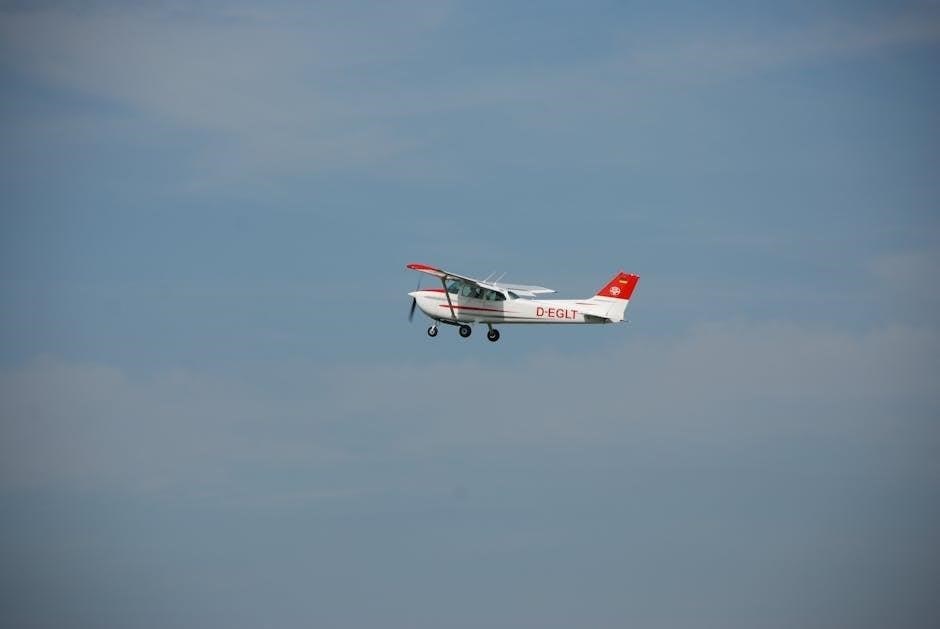
The Cessna 172S Pilot Operating Handbook (POH), readily available as a Cessna 172S POH PDF, meticulously details the aircraft’s physical characteristics. Key dimensions include an overall length of 27 feet 9 inches, a wingspan of 37 feet 9 inches, and a height of approximately 9 feet 5 inches. The cabin width is 48.5 inches, providing comfortable seating.
Empty weight typically ranges around 1684 pounds, though this can vary with installed options. Maximum gross weight is 2450 pounds. Understanding these specifications, as documented in the POH, is fundamental for proper weight and balance calculations, ensuring safe and efficient flight operations. Referencing the official Cessna 172S POH PDF guarantees access to the most current and accurate dimensional data.
Weight and Balance Considerations
The Cessna 172S Pilot Operating Handbook (POH), often accessed as a Cessna 172S POH PDF, emphasizes the critical importance of weight and balance. Maintaining the aircraft within prescribed limits is paramount for flight safety and control. The POH provides detailed charts and calculations for determining the allowable weight distribution.
Exceeding weight limits or operating outside the center of gravity (CG) envelope can severely impact aircraft performance and stability. Pilots must accurately calculate weight and balance before each flight, accounting for fuel, passengers, and baggage. The POH outlines procedures for determining the CG location and ensuring it remains within acceptable parameters. Always consult the official Cessna 172S POH PDF for precise weight and balance information.
Normal Operating Procedures
Refer to the Cessna 172S POH PDF for detailed guidance on preflight checks, starting, taxiing, takeoff, climb, and cruise procedures for routine operations.
Preflight Inspection Checklist
The Cessna 172S Pilot Operating Handbook (POH) PDF outlines a comprehensive preflight inspection crucial for ensuring airworthiness. This checklist, detailed within the POH, begins with a thorough examination of the aircraft’s exterior. Inspect the fuselage for any damage, dents, or corrosion. Carefully check control surfaces – ailerons, elevator, and rudder – for freedom of movement and security of attachment.
Wings require meticulous inspection, verifying the condition of leading edges, flaps, and fuel tanks for leaks. Landing gear tires should be checked for proper inflation and wear. The engine compartment demands scrutiny, including oil levels, coolant, and fuel quantity. Finally, the interior must be inspected, confirming proper functioning of instruments, controls, and safety equipment. Adherence to this POH-defined checklist is paramount for safe flight.
Starting and Taxiing Procedures
The Cessna 172S POH PDF details precise starting and taxiing procedures vital for safe ground operations. Before engine start, ensure the area is clear, parking brake is set, and mixture is rich. Following the POH sequence, engage the starter, monitoring oil pressure immediately upon engine ignition. After start, perform a magneto check to verify proper function.
Taxiing requires slow, controlled movements, utilizing differential braking for steering. Continuously scan for obstacles and other aircraft. The POH emphasizes maintaining situational awareness during taxi, adhering to airport signage and ATC instructions. Before takeoff, a final check of flight controls and engine instruments, as outlined in the POH, is essential. Proper execution of these procedures minimizes ground risks and prepares the aircraft for flight.
Takeoff Procedures
The Cessna 172S POH PDF meticulously outlines takeoff procedures for various conditions. Prior to initiating the takeoff roll, confirm full throttle application, proper elevator control, and unobstructed flight path. The POH specifies recommended takeoff speeds based on weight and runway length, emphasizing adherence to these limits.
During the takeoff roll, maintain directional control using rudder pedals. Monitor airspeed closely, initiating rotation at the specified Vy (best angle of climb) speed. After liftoff, establish a positive rate of climb, retracting flaps according to the POH’s recommended schedule. The POH stresses the importance of promptly addressing any engine anomalies during the takeoff phase, following established emergency procedures. Precise adherence to these steps ensures a safe and efficient departure.
Climb Procedures
The Cessna 172S POH PDF details climb procedures, emphasizing maintaining Vy (best rate of climb) or Vx (best angle of climb) speed as appropriate for the situation. After a successful takeoff and gear retraction, establish the desired climb attitude, referencing the POH’s climb performance charts for optimal settings.
The POH stresses monitoring engine instruments during climb, ensuring proper oil temperature and pressure. Adjust power settings as needed to maintain the target climb speed and prevent overheating. Be vigilant for wind shear or turbulence, making necessary corrections to maintain control. The document also outlines procedures for climbing to altitude in various conditions, including density altitude considerations. Following these guidelines ensures a safe and efficient ascent to the intended cruising altitude.
Cruise Procedures
The Cessna 172S POH PDF outlines cruise procedures, emphasizing maintaining established cruise speeds for optimal fuel efficiency and performance. After reaching the desired altitude, reduce power settings to the recommended cruise RPM, typically around 2300-2500 RPM, and adjust the mixture for optimal fuel burn.
Regularly monitor engine instruments during cruise, including oil temperature, oil pressure, and cylinder head temperature, as detailed in the POH. The document provides cruise performance charts illustrating true airspeed, groundspeed, and fuel consumption at various altitudes and power settings. Pilots should utilize these charts for flight planning and enroute adjustments. Maintaining situational awareness and adhering to the POH’s recommendations ensures a safe and efficient cruise segment.

Emergency Procedures
The Cessna 172S POH PDF details critical responses to malfunctions, including engine failure and forced landings, prioritizing pilot action and aircraft control.
Engine Failure During Takeoff
The Cessna 172S POH PDF outlines a specific procedure for engine failure occurring during the takeoff roll. Immediately, the pilot should reduce throttle, maintain directional control using rudder, and assess the remaining runway length.
If sufficient runway remains, continue the takeoff and attempt a normal climb. However, if a safe climb cannot be achieved, execute a forced landing straight ahead. The POH emphasizes maintaining best glide speed (Vg) and selecting a suitable landing area.
Prioritize airspeed control and proper flap usage to maximize glide distance. Remember to transmit a Mayday call on 121.5 MHz, providing your position and the nature of the emergency. The POH stresses quick decision-making and precise execution of the emergency checklist for optimal outcomes.
Forced Landing Procedures
The Cessna 172S POH PDF details comprehensive forced landing procedures, prioritizing pilot actions for maximizing survivability. Initially, maintain control and establish the best glide speed (Vg) as indicated in the performance charts. Quickly assess potential landing sites, favoring fields with minimal obstacles and aligned with the wind.
Secure loose items, fasten seatbelts and shoulder harnesses, and transmit a Mayday call on 121.5 MHz, relaying position and nature of the emergency. Configure the aircraft for landing – flaps as needed, fuel selector on both tanks, and master switch on.
The POH emphasizes a controlled descent and a stabilized approach. Brace for impact and follow post-landing procedures, including shutting down the engine and evacuating the aircraft swiftly. Regular review of these procedures is vital for preparedness.
Performance Data
The Cessna 172S POH PDF contains vital performance charts detailing takeoff/landing distances, cruise speeds, climb rates, and short-field landing techniques for pilots.
Takeoff and Landing Distances
The Cessna 172S Pilot Operating Handbook (POH) PDF meticulously outlines takeoff and landing distances under various conditions. These distances are critically dependent on factors like aircraft weight, runway surface, temperature, and wind. Pilots must consult the POH charts to determine required runway length for specific scenarios.

The POH provides tables and graphs illustrating distances required for both normal and short-field takeoff and landing operations. Understanding these figures is paramount for safe flight planning and execution. Variations in flap settings, altitude, and obstacle clearance significantly impact these distances, necessitating careful consideration before each flight. Accurate calculations, based on the POH data, are essential for preventing runway overruns or undershoots.
Furthermore, the POH details how to adjust these distances based on real-world conditions, ensuring pilots have the information needed for safe and informed decision-making.
Short Field Landing Techniques (61 KIAS, 30 Flaps)
The Cessna 172S POH PDF details specific techniques for short-field landings, emphasizing precision and control. Approaching at 61 KIAS with 30 degrees of flaps is a core element, maximizing lift at reduced speed. Maintaining a stable approach with sufficient power to control the glide path is crucial for a successful landing within a minimal distance.
Pilots should anticipate a higher sink rate and reduced forward visibility with this configuration. The POH stresses the importance of precise airspeed control and timely power adjustments to maintain the desired glide path. Slight increases in approach speed may be necessary in turbulent conditions, as noted in the handbook.
Properly executing this technique, as outlined in the POH, allows for safe landings on shorter runways, enhancing operational flexibility and safety margins.
Cruise Performance Charts
The Cessna 172S POH PDF contains detailed cruise performance charts essential for flight planning and accurate Estimated Time of Arrival (ETA) calculations. These charts illustrate true airspeed, ground speed, fuel consumption, and endurance at various altitudes and power settings. Pilots can utilize these charts to optimize fuel efficiency and determine the most suitable cruise altitude for prevailing wind conditions.
The POH provides data for different weight configurations, allowing pilots to account for passenger and baggage loads. Understanding these charts is vital for maintaining safe and efficient flight operations. Charts typically display performance data for 65%, 75%, and full throttle settings.
Accurate interpretation of these charts, as detailed within the POH, ensures informed decision-making regarding range, endurance, and fuel reserves throughout the flight.
Systems Overview
The Cessna 172S POH PDF details the aircraft’s fuel and electrical systems, providing comprehensive diagrams and operational instructions for pilot understanding and safety.
Fuel System Description
The Cessna 172S fuel system, as detailed in the POH PDF, is a relatively simple yet reliable setup. It consists of two integral wing tanks, each with a usable capacity of 26 gallons. Fuel is gravity-fed from these tanks to a three-position selector valve – Left, Right, and Both.
The ‘Both’ position utilizes fuel from both tanks simultaneously, ensuring balanced fuel consumption during cruise. A fuel strainer and fuel quantity gauges are incorporated into the system for monitoring and filtering. Importantly, each tank has its own vent to maintain proper pressure during flight.
The POH emphasizes procedures for fuel management, including switching tanks periodically to maintain balance and verifying fuel levels during preflight and en route checks. Understanding this system is paramount for safe and efficient operation of the Cessna 172S.
Electrical System Overview
The Cessna 172S electrical system, thoroughly documented in the POH PDF, is a 12-volt, direct-current (DC) system powered by an engine-driven alternator and a 12-volt battery. The alternator maintains battery charge and supplies electrical power during engine operation. The battery provides power for starting the engine and operating electrical equipment when the engine is not running.
Essential components include circuit breakers protecting various electrical circuits, a master switch controlling all electrical power, and individual switches for specific equipment like lights, avionics, and the fuel pump.
The POH stresses the importance of proper electrical system management, including monitoring voltage and amperage, understanding circuit breaker operation, and utilizing electrical equipment efficiently to avoid overloading the system. Regular checks, as outlined in the POH, are crucial for reliable operation.